.svg)
Your sales team closes a deal, marks it Closed Won, and the record effectively disappears from...
The Sales to Operations Handover Protocol That Protects Margin
A deal closes on Friday. By Tuesday, the project manager is in a Slack thread trying to figure out what was actually sold, what the client expects, and which of the four discounts the AE offered actually made it into the SOW. By the end of week two, the project is 11% under-margin and nobody has had the kickoff call yet. This is the sales to operations handover problem — and it kills profitability before a single hour gets logged.
Most services and technology firms treat the handover as a meeting. It isn't. It's a protocol — or the absence of one — and that protocol is where project margin lives or dies.
Why the Handover Is a Structural Problem, Not a People Problem
The instinct is to blame the AE. He oversold. She forgot to mention the integration. They promised a delivery date that ops never agreed to. But when this happens on every fifth deal across three different reps, it isn't a people problem. It's a systems problem.
The structural issue is that sales and operations work in two different information environments. Sales lives in the CRM, in email threads with the prospect, in proposal drafts and call notes. Operations lives in project tools, internal docs, and resourcing spreadsheets. The handover is the moment where one environment is supposed to translate into the other — and in most companies, that translation happens through a verbal briefing, a shared folder, and a hope.
No translation layer means no continuity. The information loss between "deal closed" and "project kickoff" is where unprofitable projects are born.
What Actually Gets Lost
It isn't just scope. It's the texture of the deal — the verbal concessions, the implicit promises, the client's real success criteria, the political dynamics inside the client's team. None of that fits in a SOW. All of it determines whether the project goes well.
When ops doesn't inherit that context, they execute against the document instead of against the relationship. The client feels it immediately. The PM gets blamed for being "transactional." Margin erodes from the first week.
The Conventional Fix and Why It Fails
Most companies try to solve the handover with a kickoff meeting and a handoff template. The AE fills out a form: scope summary, timeline, key contacts, special notes. The PM reads it, asks a few questions in a 30-minute call, and the project begins.
This breaks down for three reasons. First, the AE fills out the template after the deal closes, which means it's a memory exercise instead of a record of what actually happened during the sale. Second, the template is static — it captures a snapshot, not the trail of decisions and trade-offs that led to the final scope. Third, the kickoff meeting is verbal, which means anything not written down ten minutes later is gone.
The deeper failure is that the handover is treated as an event. It's a Tuesday at 3pm calendar invite. But the information that needs to transfer was generated over weeks — across presales discovery, proposal iterations, pricing negotiations, and verbal concessions on calls. None of that can be compressed into a 30-minute meeting without massive loss.
A Better Model: The Handover as a Protocol Embedded in the Sales Process
The reframe is this: the handover doesn't start when the deal closes. It starts when the deal opens.
Every artifact generated during presale — the discovery notes, the scoping decisions, the assumptions made about effort, the verbal commitments, the pricing logic — is a handover input. If those artifacts live inside the CRM as structured records instead of in someone's inbox, the handover stops being a translation event and becomes a status change. The PM doesn't get briefed. The PM reads the record.
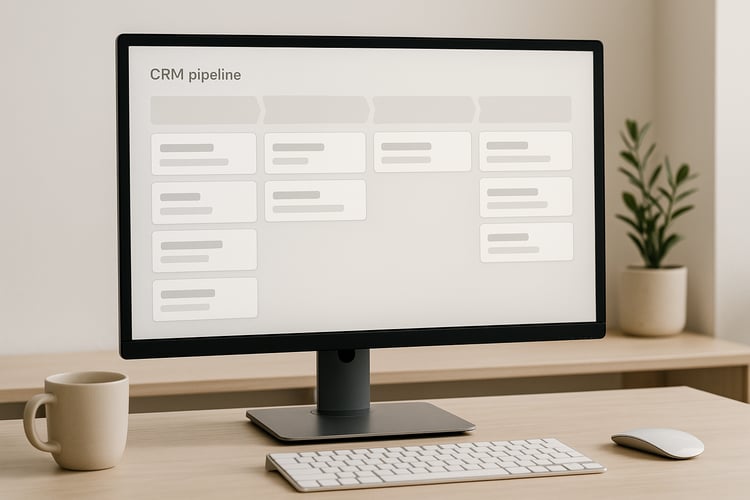
This requires building presale work as tickets, not as informal activity. A deal moving through the pipeline generates discovery tickets, scoping tickets, proposal-build tickets, and pricing-approval tickets. Each one has a deliverable attached. Each one is signed off — internally and, where relevant, externally — before the next stage. By the time the deal is marked closed-won, the entire history of what was sold, why it was priced that way, and what was promised exists as a structured record inside the CRM.
The Deal Doesn't Die at Close — It Changes State
In most CRMs, a closed-won deal disappears from the AE's view. That's a mistake. The deal record needs to remain alive in the pipeline, moving into stages like "In Progress," "Mitigation," or "Maintenance" — so the AE can see project health, fees collected versus pending, and critical incidents without having to ask operations.
This solves a problem that nobody talks about: the AE has no incentive to fix handover quality if they never see what happens after the close. When the deal stays visible, the AE feels the consequences of a sloppy presale. That alone changes behavior more than any internal memo.
Profitability Visibility From Day One
The second half of a real sales to operations handover is financial. The deal needs to carry its cost structure with it — not in a separate ERP that ops checks once a month, but inside the CRM, on the deal record. Every invoice associated with the project (subcontractors, licenses, travel, internal allocations) rolls up into the deal as it accumulates. Margin is visible in real time.
If the project is sliding under margin, the PM sees it on day 14, not on day 90 when finance closes the books. That visibility is what makes a handover protocol actually protect profitability instead of just documenting it.
How to Build the Protocol: Practical Steps
If you're rebuilding the sales to operations handover from scratch, these are the moves that change the math on profitability:
- Convert presale activity into tickets with deliverables. Discovery, scoping, proposal build, internal pricing review — each becomes a ticket attached to the deal. The deliverable from each ticket (notes, decision log, assumptions sheet, pricing rationale) is the handover artifact. When the deal closes, the PM inherits a folder of structured records, not a memory dump.
- Trigger an automated handover ticket the moment the deal reaches the closing stage. Not a calendar invite — a ticket assigned to the incoming PM with a checklist: review presale deliverables, flag scope ambiguity, confirm resource availability, sign off. The deal cannot move to "In Progress" until the PM closes that ticket. This creates a hard gate that forces the translation to actually happen.
- Keep the deal alive in the pipeline through delivery. Use post-sale stages — In Progress, Maintenance, Closed-Won — so the AE has line-of-sight into the project they sold. Surface project health, incident count, and billing status on the deal record itself. The AE shouldn't have to message the PM to know what's happening.
- Roll up costs into the deal record in real time. Every invoice — supplier payments, contractor hours, license fees — associates back to the deal. A rollup field calculates running margin. The PM, the AE, and the GM see the same number on the same screen, updated daily, without anyone exporting anything to Excel.
- Separate deals when the client has multiple workstreams. A single client with three concurrent projects is three deals, not one mega-deal with three workstreams stuffed inside. Each deal carries its own handover, its own PM, its own margin. Lumping them together is the fastest way to lose visibility into which workstream is bleeding.
Early Warning Signs Your Handover Is Failing
You don't need a six-month audit to know whether your sales to operations handover is leaking margin. The symptoms show up weekly:
- PMs ask the AE "what did you actually promise?" more than once per project
- The kickoff call uncovers scope items the SOW doesn't mention
- Finance reports project margin three weeks after the project ends
- The same AE oversells the same way on three consecutive deals without consequence
- Operations builds private spreadsheets to track "what sales actually sold" because the CRM doesn't have it
Any one of these in isolation is a problem. Two or more is a structural failure. Five means the handover doesn't exist — there's just a moment of confusion every time a deal closes.
What Becomes Possible When the Handover Is Built Right
When the sales to operations handover is a protocol instead of a meeting, project margin stops being a quarterly surprise. The PM starts on day one with a structured record of every commitment, every assumption, and every cost expectation. The AE stays accountable to what they sold because they can see how it's being delivered. The GM gets margin visibility without having to chase three departments for spreadsheets. The friction between sales and operations — the political tax that drains energy from every leadership meeting — goes away because the system holds the truth and nobody has to argue about who said what.
If you want to see exactly what this protocol looks like when it's built inside a CRM — the ticket structures, the deal stages that survive past close, the cost rollups, the handover automation — this is the model we implement for companies that sell projects. It's the same architecture we've used to take services firms from inheriting black boxes to running projects with real-time margin visibility from day one.
project profitability ,
sales operations alignment ,
B2B operations ,
professional services operations ,
CRM implementation ,
HubSpot for services firms