.svg)
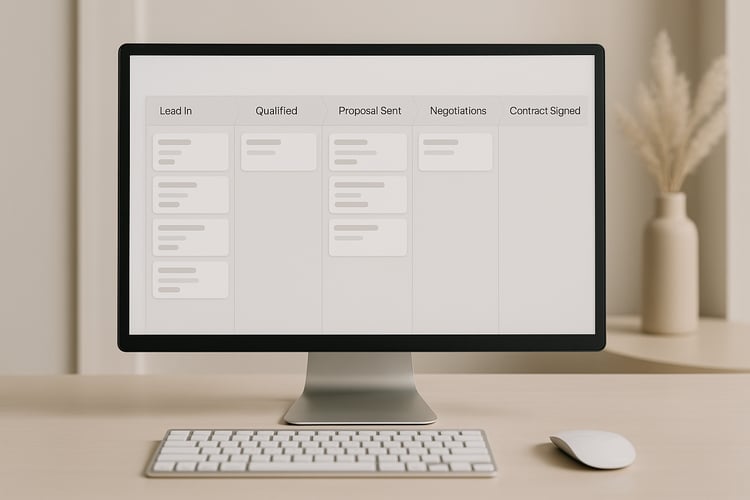
Your ops director found out about the delay in the client meeting — not in your system The client...
The Point Where Informal Operations Stop Working
The deal closed. Operations found out on Monday.
Your salesperson closed a $180,000 project on Friday afternoon. By the time the operations lead heard about it — through a Slack message, not your CRM — the client had already sent three emails with scope questions nobody on ops had seen.
That's not a communication problem. That's what informal operations look like when the company is too big for them.
Informal operations aren't a failure — they're how every good company starts
When you're running a 12-person shop, informal works. You know every project. You know who's overloaded. You know what was promised because you were in the room. The system is you, and you're fast.
The problem isn't that informal operations are bad. The problem is that they don't scale — and the moment they stop scaling, it's not gradual. It breaks in specific places, in a specific order.
Where it breaks first: the handoff
The first fracture point is always the transition from sales to delivery. In a small operation, the person who sold is often the person who delivers, or at minimum they sit three feet apart. Context transfers without a system.
Past a certain headcount — usually somewhere between 20 and 40 people — that stops being true. The salesperson closes the deal. The delivery team inherits it. And everything that lived in the salesperson's head, their inbox, their notes app, the WhatsApp thread with the client — none of that transfers automatically.
So the delivery team starts from a worse position than the client expects. They ask questions the client already answered. They make assumptions the salesperson already corrected. The client's first experience of your delivery team is being asked to repeat themselves.
That's margin erosion, right at the start of the project, before your team has done a single hour of work.
Where it breaks second: financial visibility
You close a project. You scope it. You staff it. Three months in, someone asks: are we making money on this?
In an informal operation, answering that question requires a meeting. Someone has to pull the original proposal, check what was invoiced, check what was paid to subcontractors, account for the hours the team actually logged versus what was estimated. This takes time. It's often incomplete. And by the time you have the answer, the project is already over.
The result: you find out a project was unprofitable after it's done. You can learn from it, but you can't fix it.
This is the part that doesn't show up in lost deals — it shows up in margins that don't match what the sales pipeline promised. The projects look fine from the outside. The P&L tells a different story.
Where it breaks third: the people you keep losing
The operations lead who's been with you for six years knows where everything is. She knows the history of the client in Building 4. She knows why the Martinez account has a non-standard payment term. She knows which subcontractor to call when your primary goes dark.
That knowledge lives in her head, not in your systems.
When she leaves — for whatever reason, people leave — that knowledge walks out the door with her. Her replacement spends the first three months asking questions nobody can fully answer. Clients notice. Projects slow down. Some relationships don't survive the transition.
In an informal operation, institutional knowledge is a liability disguised as an asset. It feels like a strength until it's gone.
The specific moment you'll recognize this
It's not a slow realization. It's a specific moment: your operations lead walks into a client meeting and finds out mid-conversation that the project has a problem the client's been sitting on for two weeks — because the only person they'd told was the salesperson, and the salesperson didn't have a clean way to flag it inside your organization.
Or: a Friday afternoon Slack message from your CFO asking why last quarter's margins were 8 points below forecast, and you don't have an answer that doesn't require three days of digging through spreadsheets.
Or: a client calls to ask about the status of a deliverable, and you have to put them on hold to find out — from your own team — what's happening on a project your company is executing.
These are the moments informal operations become visible. Not as a system — as an absence of one.
The irony of scaling with more tools
The instinct when this starts happening is to add tools. A project management app. A better Slack structure. A shared drive with actual folders. An updated CRM that nobody migrated properly.
This doesn't solve the problem. It adds coordination overhead on top of the original coordination problem.
Now you have five places where information might live, and no clear rule about which one is authoritative. Your ops lead checks the CRM. Your PM checks Monday.com. Your finance person checks the spreadsheet. Your salesperson checks their email. Nobody's wrong — and nobody has the full picture.
Fragmentation isn't solved by more tools. It's solved by a model: a decision about what lives where, how it connects, and what happens automatically when something changes in one place.
What the operation looks like when this is solved
When a deal closes, delivery gets an automatic briefing with everything that was captured during the sales process — scope, client context, what was promised, what the client said they cared about. No meeting required. No salesperson having to remember to forward an email.
When a project starts, the cost clock starts too. Every invoice, every subcontractor payment, every internal hour tracked — it rolls up automatically against the project record. The margin is visible in real time, not reconstructed after the fact.
When someone on the delivery team updates the project status, the salesperson can see it without asking. When the client has a concern, there's a clear place to log it that both sides of your organization can see.
None of this requires a different team. It requires a different architecture — a decision about how information flows through your operation, made once, and then enforced by the system rather than by reminders and good intentions.
This is the decision point for companies at your stage
The companies that figure this out between 30 and 80 employees don't just run more smoothly. They become structurally harder to compete with. They can take on larger clients. They can staff projects faster. They can answer financial questions in seconds that their competitors answer in days.
The companies that don't figure it out keep growing, but the chaos grows with them. They hire more coordinators to manage the coordination problem. They build more spreadsheets to track what their systems can't track. The margin pressure becomes structural.
If this is recognizable — if the handoff problem, the margin visibility problem, or the institutional knowledge problem sounds like something happening inside your company right now — the next step is understanding what a structured operation actually looks like for a business like yours.
That's exactly what this page is built to show you.