.svg)

The meeting that reveals everything Your best project manager takes a two-week vacation. Before she...
What a Company Looks Like When It Doesn't Depend on One Person to Function
Your best operations person is on vacation. Now what?
Not a crisis—just a Tuesday. But your project manager is unreachable, a client is asking for a status update, and nobody else can pull the answer from the system. They can pull it from Marcus, or from the folder Marcus built, or from the Slack thread Marcus started six months ago. Marcus isn't here. So now someone is texting Marcus on his vacation.
This isn't a Marcus problem. Marcus is good at his job. The problem is that your operation was built around what Marcus knows, not around how work actually flows. And the moment Marcus isn't available—for a week, for a month, permanently—the operation doesn't slow down. It stops.
The goal isn't to find better people. It's to build something that works without depending on the right ones being available.
Companies that scale past this problem don't do it by hiring more experienced people. They do it by designing operations where the process lives in the system, not in someone's head.
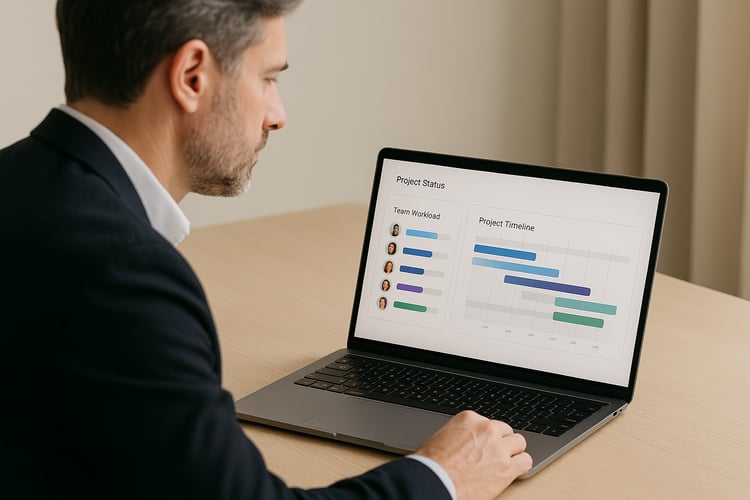
The difference sounds abstract until you see it in practice. In a system-dependent operation, a new project manager can open a deal and see the full history of a client: what was scoped, what was promised, what changed during delivery, what the client pushed back on, what the team flagged as a risk. No briefing from the previous PM. No digging through email threads. No asking Marcus.
That information doesn't appear by accident. It appears because someone designed where it lives and made it mandatory for it to live there—not in someone's inbox, not in a shared drive nobody updates, not in a Slack thread that disappears into history.
What the dependent version looks like, specifically
The dependent version usually has tools. Most companies at this stage aren't running on paper—they have a CRM, a project management platform, maybe a shared drive, maybe Slack or Teams. The problem isn't the absence of technology. It's that the technology holds data, not process.
The CRM has contact records. But it doesn't tell you what was agreed in the last proposal or who approved the scope change. The project management tool has tasks. But it doesn't show how this project connects to the deal that originated it, or what the client's expected margin was when the deal closed. The tools are there. The architecture isn't.
So the team does what teams do: they fill the gaps with people. Marcus becomes the connective tissue between the CRM and the PM tool because nobody else remembers how the handoff is supposed to work. The senior account manager becomes the de facto source of truth on client expectations because that's the only place that information reliably exists.
When those people are available, the operation runs. When they're not, the operation waits.
What the system-dependent version looks like — concretely
Here's what changes when the architecture is designed correctly, step by step.
A deal closes. The salesperson doesn't send an email to operations. The system detects the stage change and automatically fires a structured briefing to the operations team: what was scoped, what was promised, what the client signed off on. Nothing gets lost in translation because nothing depended on anyone remembering to send it.
During delivery, the project isn't a folder—it's a live record. Costs are logged against it in real time. Timeline changes are documented when they happen. If a client raises a concern, it's captured in the project record, not scattered across a thread where five people are CC'd and nobody owns the resolution.
When the deal closes, the salesperson opens it and sees actual margin—not the estimate from the proposal, but real margin after costs. No request to finance. No end-of-month reconciliation. The number is there because the system was built to put it there.
And when a new person joins—or when Marcus goes on vacation—they open the record and the context is there. The previous project manager's judgment didn't leave with them. It's in the system.
The structural shift that makes this possible
The difference between these two versions isn't which tools you use. It's whether your tools hold data or hold process.
Most implementations treat the CRM as a contact database and the PM tool as a task list. Those tools can do those things. But they leave the process—the logic of how work moves from one stage to the next, who owns what, what information needs to travel with the work—as something that lives in people's heads.
When you design the architecture correctly, the tools become the process. The deal record is connected to the project record. The project record is connected to actual costs. The handoff between teams is a system event, not a human decision that depends on someone remembering to do it. The information that needs to move, moves—because the system was built to move it.
What this looks like as a goal, not a problem
If you're reading this before the crisis—not after losing Marcus, but while Marcus is still there—the question is: what would your operation look like if every person on your team could pick up any project, at any stage, without a briefing?
Not because your team has perfect memory. Because the system holds the context they need. Because the handoffs are designed, not improvised. Because the institutional knowledge your senior people carry in their heads is in the record, where anyone can access it.
That's not a technology question. It's an architecture question. And the companies that answer it correctly don't just survive when key people leave—they scale faster because growth doesn't require adding more people who have to memorize how everything works.
If you sell projects—consulting, technology, professional services, anything where the work is custom and delivery depends on what was actually sold—this is what that architecture looks like when it's built for your type of operation, with examples from companies that have already made the shift.