.svg)
You find out something went wrong the same way your client does Not from your PM. Not from your...
What Good Project Visibility Actually Looks Like for a Business Owner
You're not uninformed because you don't have tools. You're uninformed because your tools don't talk to each other.
You have a CRM. You have a project management tool. You might have a finance system. And still, when someone asks you how a specific project is going, your honest answer is: "I'd have to ask."
That's not a discipline problem. That's an architecture problem. The information exists — it's just scattered across three systems, two spreadsheets, and someone's memory.
What you want isn't a dashboard. It's the ability to know without asking.
When most business owners imagine "visibility," they picture a dashboard with green and red indicators. That's not wrong, but it's incomplete. A dashboard only helps if the data feeding it is structured, current, and connected to how your business actually runs.
What you actually want is simpler to describe: you want to open a record and know, in 30 seconds, whether a project is on track — without calling your operations manager, without scheduling a status meeting, without waiting for someone to build you a report.
That's a different problem than "we need a dashboard." It's a problem of how information is captured and connected in the first place.
The visibility that's actually worth building — what it looks like in a real system
In a system that's built right for a company that sells projects, here's what a business owner sees when they open an active deal:
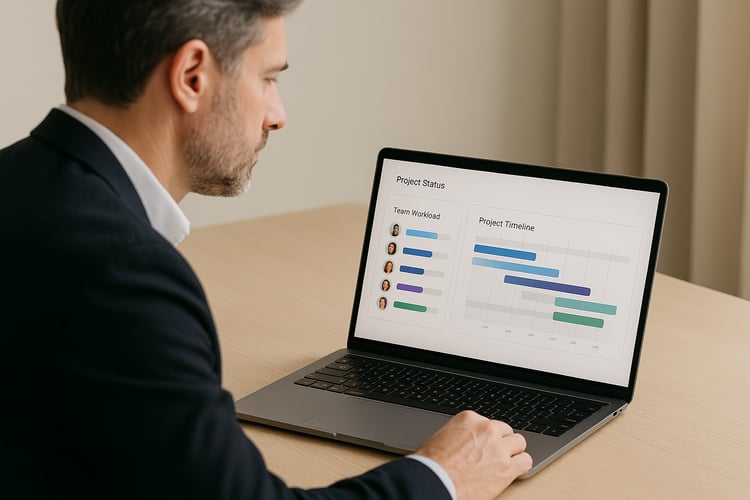
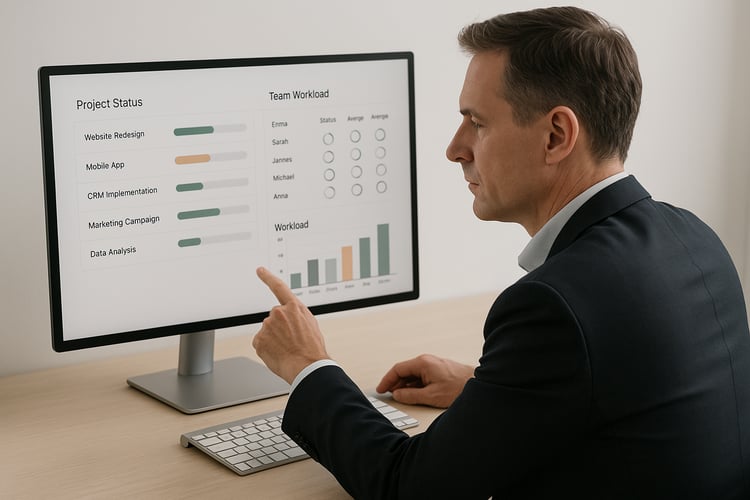
They see the current stage of the project — not just "in progress," but where specifically in the delivery process it sits. They see what was sold, which is the scope the client approved. They see what's been invoiced and what's pending. They see if there are open incidents or escalations. They see the last meaningful update from the team — not a timestamp, but a note that tells them something real.
None of this requires a meeting. None of it requires asking someone. The information is there because the system was built to capture it as work happens — not as a separate reporting task that someone remembers to do on Fridays.
Why most companies that have tools still don't have this
The problem isn't the tools. HubSpot, Asana, Monday, QuickBooks — any of these can hold good information. The problem is that each tool was implemented separately, for a specific team, without a shared architecture underneath.
Sales closes a deal and it lives in the CRM. Operations runs the project and it lives in the project tool. Finance tracks invoicing and it lives in the accounting system. Nobody designed how these three systems would talk to each other — so they don't. The owner sits above all three and has access to none of them in a way that's actually useful.
The fix isn't adding another tool. It's redesigning how the existing systems connect — and in most cases, consolidating the operational record into one place where the relationship between what was sold, what's being delivered, and what's been charged is always visible in the same screen.
What changes when the system is built this way
When the architecture is right, a few things shift immediately. The operations manager stops being the person everyone calls to find out what's happening. The status meeting stops being the mechanism for keeping leadership informed — it can become a space for actual decisions instead of updates. And the owner can look at any active project on a Tuesday afternoon and know whether to worry about it.
That last one is underrated. Not because it saves time — though it does — but because it changes how you operate as a leader. When you know you can check, you stop carrying the anxiety of not knowing. The business feels more like something you're steering and less like something you're hoping goes well.
What this looks like when it's already running
One company we work with — a product distribution business with multiple sales reps and a separate operations team — had the same setup you probably recognize: CRM for sales, a separate system for operations, accounting in another tool entirely. The owner was calling his operations director three times a week just to get a status on active orders.
After the implementation, that stopped. Not because anyone changed their habits, but because the information was finally connected. The owner opens a record and sees what was ordered, what's been processed, what's been invoiced, and whether anything is flagged. Three calls a week became zero — not because there was more discipline, but because there was no longer a reason to call.
That's the difference between having tools and having a system that works. The tools were already there. What changed was the architecture connecting them.
If you want to see exactly how this is structured — the actual model built for companies that sell projects, not a generic demo — the page below shows the architecture, the process, and what you'd need to make it work for your operation.
See how the system is built for companies that sell projects →