.svg)
The deal closed. Operations found out on a group chat. Your sales rep closed a project. A real one...
You Bought HubSpot. Your Team Still Runs on Spreadsheets. Here's Why.
The deal closed. Your ops team found out on WhatsApp.
Your sales rep closed a $180,000 project on Friday afternoon. By Monday morning, your delivery lead still didn't know the scope, the timeline, or what was promised on pricing. Someone had to schedule a meeting to transfer information that should have already been in the system.
You have HubSpot. You've had it for fourteen months. And somehow, the handoff between sales and operations still happens through a forwarded email chain and a 45-minute briefing call that three people attend and two people actually needed.
This is not a HubSpot problem. HubSpot is doing exactly what you configured it to do. The problem is what you configured it to do.
What "using HubSpot as expensive Excel" actually looks like
It looks like this: contacts in HubSpot, project updates in Monday.com, financial tracking in a spreadsheet your ops director built in 2021, and the actual status of any given engagement living inside the head of whoever owns it.
It looks like your project managers getting asked "how's the Martinez project going?" and having to piece together an answer from three different places before they can respond. It looks like your sales director opening a deal record and seeing a closed-won tag with no indication of whether delivery has started, whether there's been a scope issue, or whether the client is happy.
You bought a connected system and built four disconnected ones inside it. HubSpot became the place where contacts live — not the place where your business runs.
Why this happens — and it's not your fault for not knowing
HubSpot ships as a blank canvas. The default setup is built around one model: a product company with a linear sales motion. Lead comes in, rep works it, deal closes, done. The pipeline ends at closed-won because for a product company, delivery is fulfillment — it happens automatically or separately, and sales doesn't need to see it.
Your company doesn't work that way. You sell projects. The thing you sold doesn't exist yet when you close the deal. Delivery is where you actually earn the margin — or lose it. Your sales rep needs to see what's happening in delivery because the client is going to ask them. Your delivery lead needs to see what was promised in the proposal because that's what they're building.
Nobody told HubSpot that when you set it up. So it gave you what it gives everyone: a deal record that ends when the contract is signed.
The gap between a CRM and an operating system
A CRM tracks relationships. An operating system runs a business. Most HubSpot implementations for professional services companies end up as the first thing when they should be the second.
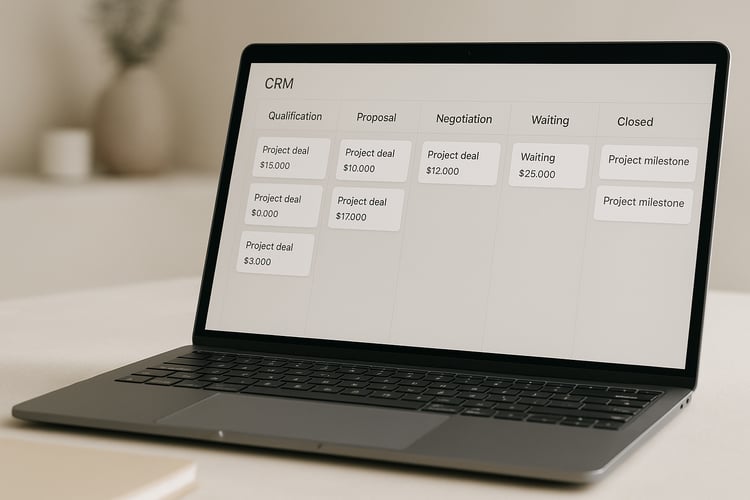
Here's what the difference looks like in practice. In a CRM-only setup, your deal record has a contact, a company, a dollar amount, and a close date. When the deal closes, it moves to closed-won and largely disappears from the active workflow of your team. Someone exports a report at the end of the quarter to see how sales did.
In an operating system built on HubSpot, that same deal record connects forward into delivery. The moment it closes, your delivery pipeline activates — not because someone manually created a project, but because the architecture makes it automatic. Your project manager sees the handoff notes from the proposal stage. Your financial tracking shows fees invoiced versus fees collected in real time, without leaving the record. When there's a scope issue, it's logged as an incident — and your account executive can see it without scheduling a call.
The tool is the same. The architecture is completely different.
What architecture actually means — concretely
Architecture is the decision of which objects exist in your CRM, how they relate to each other, and what moves automatically versus what requires a human.
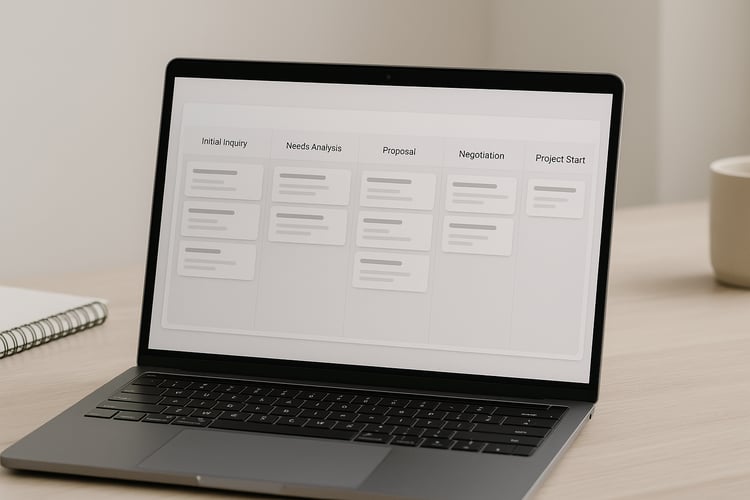
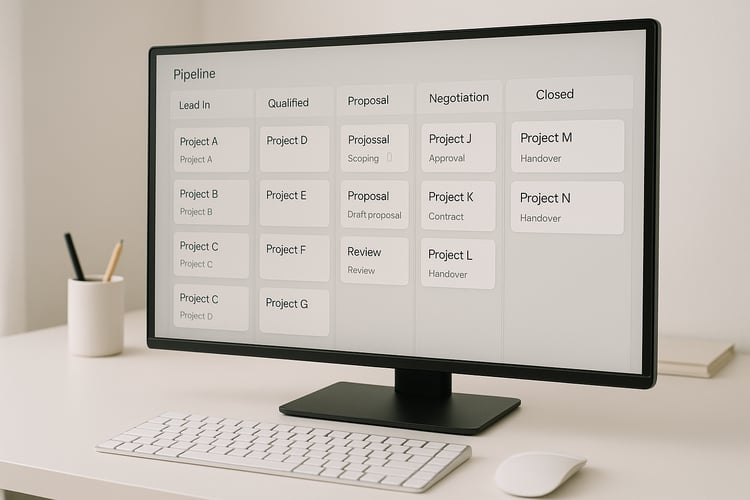
For a company that sells projects, that means a few specific things need to be true. Each project needs its own record — not a field on the deal, not a note in the contact timeline, but a first-class object that holds scope, costs, team, status, and client communications. Your delivery teams need their own pipelines with their own stages and their own KPIs, separate from the sales pipeline but connected to it. Financial data — what was billed, what was collected, what the margin looks like — needs to live inside the record, not in a parallel spreadsheet.
When those things are true, something shifts. Your ops director stops getting asked for status updates because the status is visible. Your account executive can tell a client "let me check" and actually check, in thirty seconds, by opening a record. Your CEO can look at a dashboard on a Tuesday morning and see the health of every active engagement without a meeting.
None of that requires a different tool. It requires someone to design the architecture before implementing the tool.
The sequence that most implementations skip
Most HubSpot implementations start with the tool and figure out the business later. A consultant gets access to your portal, starts building pipelines, asks your team what fields they want, and delivers something that looks complete because it has data in it.
The sequence that works is the reverse. Before touching HubSpot: map how your business actually runs. What does a deal look like from first conversation to final invoice? Who touches it and when? What information does each person need to do their job without asking someone else? What are the moments where information currently falls through the cracks?
When that map exists and your team has agreed it reflects reality, then the HubSpot build is just translating a blueprint into configuration. The decisions are already made. There are no surprises during implementation because there's nothing to discover — it was already discovered before anyone opened the portal.
That's why a well-designed implementation can go live in weeks rather than months. Not because shortcuts were taken — because the work that matters happened first.
The version of your operation you haven't seen yet
There's a version of your business where a deal closes and your delivery team has everything they need before they ask a single question. Where your sales rep knows a project is running two weeks late before the client brings it up on a call. Where your financial director can see the margin on every active project on a single screen, updated in real time, without touching a spreadsheet.
That version doesn't require a different tool. You already have the tool. It requires someone to design what your operation should look like inside it — and build it that way from the start.
You can see exactly what that looks like for a company that sells projects — before committing to anything — at the link below. The model is there. No meeting required to explore it.